 FDA
FDA 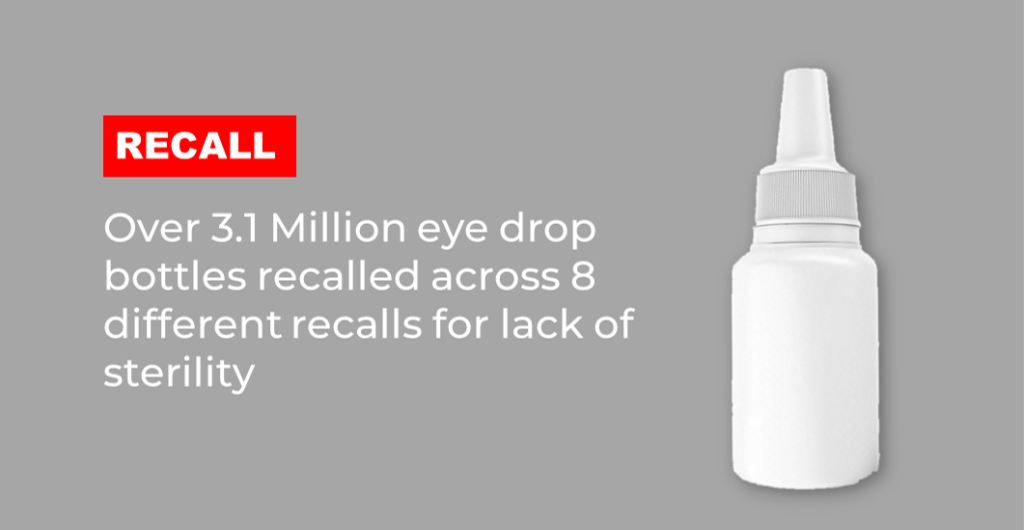
Over 3.1 million bottles of eye drops are now subject to a contaminated eye drops recall — spanning eight separate FDA recalls, all traced to a single contract manufacturer: K.C. Pharmaceuticals of Pomona, California. The reason for every one of these recalls is identical: lack of assurance of sterility. What makes this situation uniquely dangerous for consumers is that these products were not sold under one brand name. They were packaged under dozens of store-brand labels and distributed through virtually every major pharmacy and retailer in the country — Walgreens, CVS, Kroger, Publix, H-E-B, Meijer, Rite Aid, Dollar General, Harris Teeter, Discount Drug Mart, and even military exchanges. A consumer checking for a recall under their store’s brand name might never realize that the product in their medicine cabinet was manufactured in the same facility, on the same lines, with the same sterility failure as seven other recalled products.
This is not the first time unsterile eye drops have posed a serious public health threat
This is not the first time unsterile eye drops have posed a serious public health threat. In 2023, EzriCare and Delsam Pharma artificial tears — manufactured by Global Pharma Healthcare in India — were linked to an outbreak of extensively drug-resistant Pseudomonas aeruginosa that the CDC confirmed infected 81 patients across 18 states, caused 4 deaths, left 14 patients with permanent vision loss, and resulted in 4 surgical eye removals. That manufacturer’s FDA inspection revealed no microbial testing, no preservatives in multi-use bottles, and no tamper-evident packaging. A contaminated eye drops recall is not a minor inconvenience — it is a medical emergency in a bottle. As the Cleveland Clinic explains, even routine contamination from touching a dropper tip can lead to “dangerous infections and permanent eye damage.” When the sterility failure happens at the manufacturing level, the consumer has no way to detect it before use.
So what should consumers do right now? First, check every bottle of store-brand eye drops in your home — not just the brand name, but the manufacturer listed on the label or packaging. If K.C. Pharmaceuticals is the manufacturer, stop using the product immediately regardless of which store brand it carries. Second, do not assume that because you bought eye drops at a trusted pharmacy, they are safe — contract manufacturing means the same product can appear under 20+ different labels. Third, if you experience redness, pain, swelling, discharge, or changes in vision after using any eye drops, seek medical attention immediately and bring the bottle with you. And finally, return any recalled product to the retailer for a full refund.
Final Thoughts
When a single manufacturer’s sterility failure cascades across eight recalls and dozens of store brands, staying informed becomes nearly impossible without help. RecallSentry™, operated by the Center for Recall Safety, consolidates FDA, CPSC, USDA, and NHTSA recalls into one searchable system — so you can check whether the products in your medicine cabinet are safe in seconds, not hours. Visit RecallSentry and let us do the tracking so you can protect your family.
Learn more about how RecallSentry helps protect families here:
https://centerforrecallsafety.com/recallsentry
How this Article is Relevant
For more information related to this topic, refer to this recent FDA recall: K.C. Pharmaceuticals Eye Drops Recalls — FDA Event 98533 (8 Recalls, 3.1 Million Bottles).
 RecallSentry™ App
 CPSC Recalls
 USDA Recalls
 NHTSA Recalls